
Home / Specifications
VolumeSense specifications
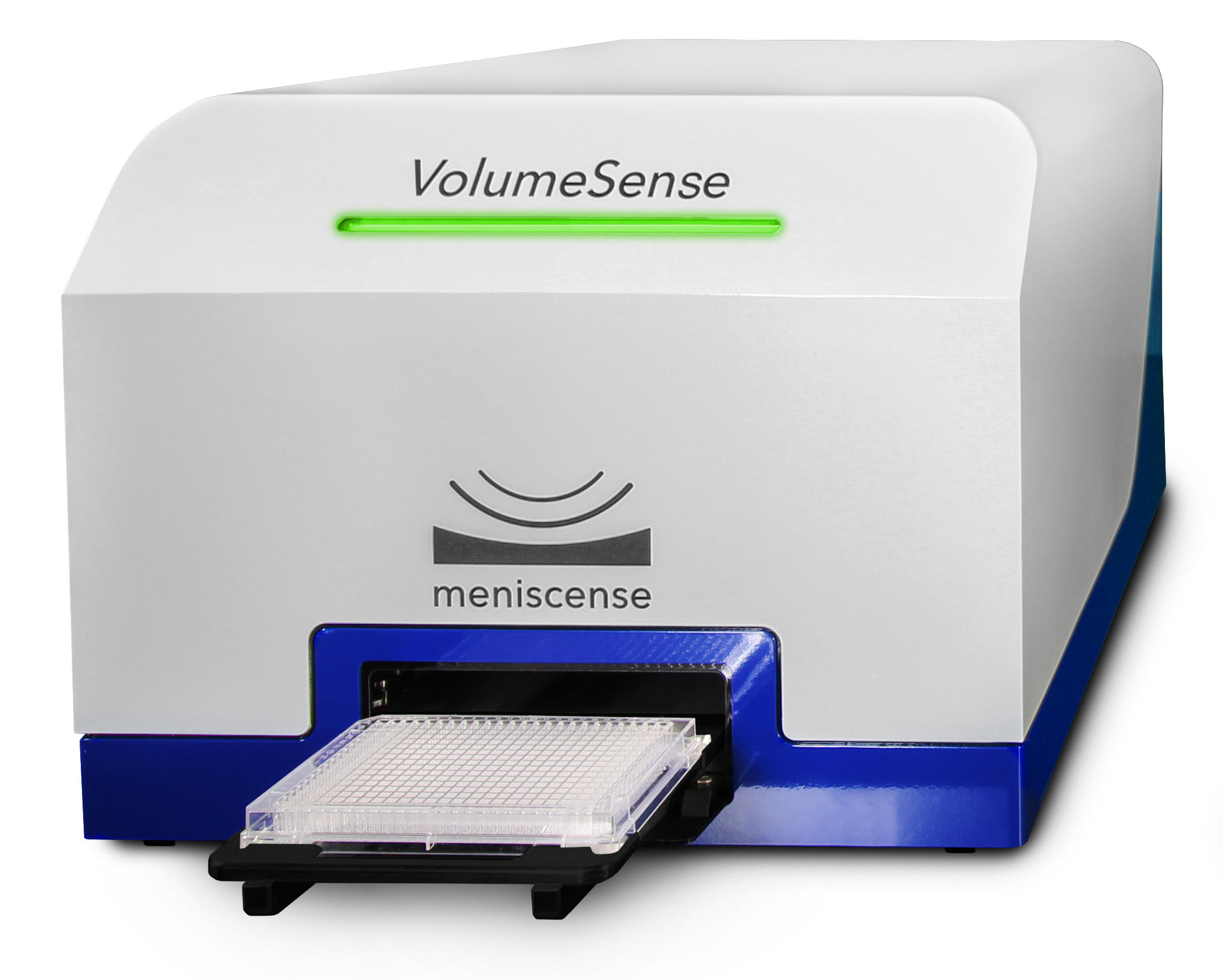
Volume verification by direct, non-contact measurement of the volume in every well, based on low-coherence interferometry.
Measurement performance
| 96 flat bottom | 384 flat bottom | 96 PCR | 384 PCR | |
|---|---|---|---|---|
| Minimum well volume | ≥40 µL | ≥8 µL | ≥5 µL | ≥3 µL |
| Repeatability | 50 nL | 30 nL | * | * |
| Read time | 40 s | 115 s | 40 s | 115 s |
Minimum well volume is set by the requirement for a wall-to-wall meniscus and varies by labware geometry and liquid. Repeatability scales with well cross section and is stated for standard well geometries. In our testing, the VolumeSense® instrument agrees with independent gravimetric determination of the same dispense to within 1%.
*In conical wells the cross section changes with depth, so repeatability varies with fill height.
Labware and liquids
The instrument needs three things from a well: optical access from above, enough liquid to form a wall-to-wall meniscus, and a characterized well geometry. Tell us which plates you’d like to run and give us an idea of what’s in your solution. We can often answer from the dozens of plate and liquid combinations we have measured for liquid handler verification; if not, we can work together to characterize the performance for your use case.
| Format | ANSI/SLAS footprint, 24-, 96- and 384-well plates or 2D tubes |
|---|---|
| Well geometry | Any†; flat bottom and PCR are the most extensively characterized. |
| Maximum labware height | 17 mm for the VolumeSense instrument, 45 mm for the VolumeSense DW instrument |
| Plate material, color and opacity | Polystyrene and polypropylene in different colors, turbidities and surface coatings extensively tested. |
| Liquid classes | Aqueous buffers, detergent-containing buffers, organic solvents, protein solutions |
†In V-bottom or similar geometries, a sharp shoulder between conical and cylindrical sections can pin the meniscus when the liquid surface lies in this transition region.
Software and data
| Report output | Per-plate or per-run PDF report with plate maps, per-tip, per-dispense, and global statistics, variable replicate counts and pass/fail against preconfigured criteria |
|---|---|
| Data export | CSV and JSON generated for every plate and saved to configurable folders |
| API | REST API and Python SDK available |
| User accounts | Tiered permissions and password access, configurable |
Physical and electrical
| Dimensions | 24 × 14.3 × 11.5 in (61 × 36.2 × 29.2 cm) |
|---|---|
| Weight | 30 lb (13.6 kg) |
| Electrical | 110–240 VAC, 50–60 Hz, ~3 A max |
| Automation compatible | Plates inserted by hand or by robot arm |
Don’t see your plates or liquids?
Tell us which plates and liquids you run. We can often answer from combinations we have already measured. If not, send us a plate — we’ll run it and go through the results with you.